Reducing Environmental Impact Through Product Lifecycles
Limiting consumption of resources by taking an environmentally conscious approach during the development of products and business promotion is considered one of Roland DG’s core missions on the way to achieving a sustainable society. Roland DG focuses on the conservation of energy and resources during each stage of a product's lifecycle—from design and development through to transportation, use and disposal—with the aim of achieving a low-carbon society and recycling-oriented society.
Energy-Efficient Designs for Products
Roland DG’s products are used in countless day-to-day operations, and as such they are designed and developed with energy-efficient operation and reduce actual power consumption in terms of productivity in mind. All Roland DG printers feature sleep mode, which is designed to minimize power consumption as much as possible when in standby. Roland DG is also expanding its lineup of printers that use UV inks, which consume less power during printing than low-solvent inks and water-based resin inks and contribute to reducing GHG emissions. The company is working to reduce energy consumption and carbon emissions across its entire product portfolio without sacrificing the properties or productivity of each ink or product.
Resource-Efficient Products
To ensure that products continue to be resource-efficient, targets for new products are set during the planning stage with the aim of reducing the product weight and the number of parts compared to the previous model, and monitor the development process. Roland DG incorporates a platform concept into the design and development of its products, reflecting customer needs on top of a common basic design that forms the foundation of its product lineup, thereby achieving both development efficiency and diversity in its product lineup. In basic design, it is possible to incorporate sustainability considerations such as inventory efficiency through component standardization and modularization, efficient use of resources through reduction in the number of components, and ease of component reuse and recycling. We plan to further develop this approach in the future.
Reducing Environmental Impact in Business Operations
We are advancing efforts to reduce environmental impact by transforming our business portfolio and evolving our business model.
Our VersaSTUDIO series in the Digital Fabrication business features compact desktop printers, cutting machines, and 3D manufacturing products designed to save energy and resources compared to conventional large-format commercial inkjet printers. Guided by our “reduction contribution” philosophy, we strive to reduce GHG emissions for society as a whole. We will further refine our traditionally strong concepts of “compactness,” “ease of operation,” and “SOHO/hobby applications,” aiming to minimize environmental impact compared to our baseline large-format commercial inkjet printers.
Our expanding connected services leverage IoT technology to monitor product usage and equipment status, enabling timely and efficient provision of necessary maintenance and repair parts. This contributes to extending product lifespans and reducing waste. Based on acquired data, we will explore opportunities to create various environmental added values. These include optimizing orders, production, and inventory levels for parts and ink; reviewing energy and resource efficiency; and leveraging these insights to promote a circular economy.
Transporting Products in an Efficient and Environmentally Friendly Manner
In order to reduce the number of transport containers and GHG emissions, Roland DG designs product packaging sizes to be optimal for loading into containers for transporting by ship. Roland DG also uses vanning software that optimizes the loading of cargo by calculating the best way to fit items of different shapes and sizes into a container. Reducing the number of containers leads to a reduction in the number of drivers and the number of miles traveled in truck transport, which also contributes to solving social issues such as long working hours for drivers and reduced transport capacity due to driver shortages.
40-foot container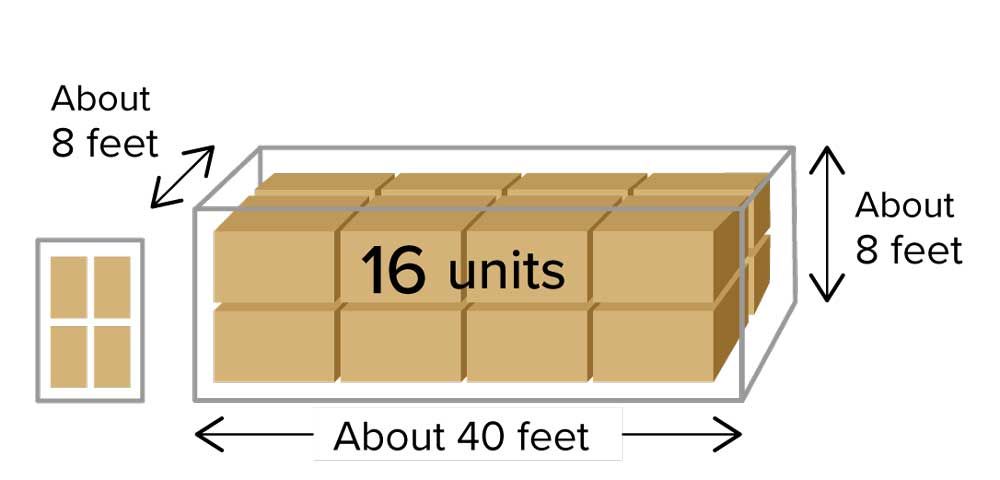

40-foot High Cube container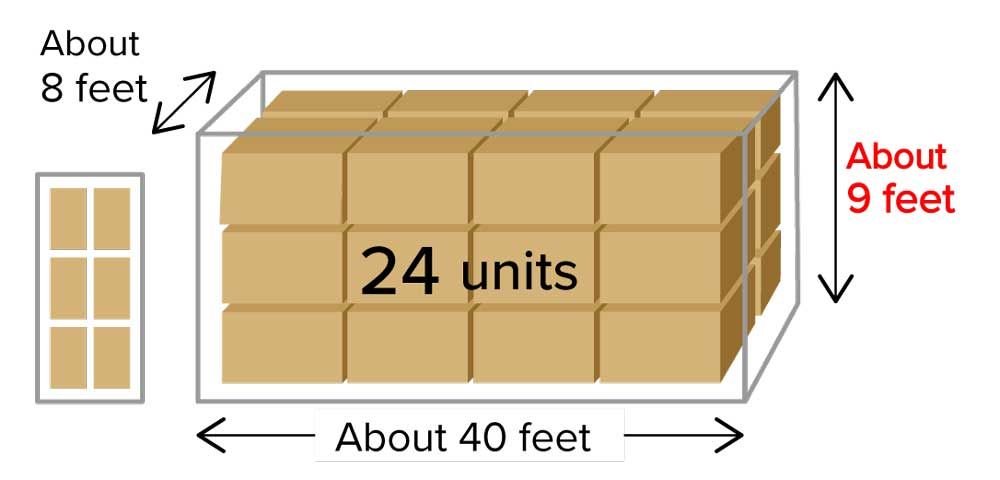
Reducing the Amount of Wasted Ink
The inside of inkjet heads need to be cleaned regularly using fresh ink so that inkjet printers can continue to be used in prime condition. Improvements are constantly being made to the operating sequence of Roland DG inkjet printers so that the minimum amount of waste ink is generated during cleaning.
Printer Chassis Designed for Easier Maintenance and Recycling
Printer bodies use screws for joints to eliminate welding where possible. This design makes disassembly easier, which results in easier maintenance and better recyclability.
Lower Environmental Impact with Pouch-Type Ink and Paper-Based Ink Cartridges
Since 2015, Roland DG has been switching from plastic cartridges in favor of environmentally friendly pouch-type container. This is more than 30% lighter in weight per 1 ml of ink compared to plastic cartridges, which not only helps cut down CO2 emissions during transportation, but also makes sorting and disposal of used inks easier and significantly reduces the amount of waste.
In 2023, from the perspective of promoting resource recycling related to plastics, Roland DG launched paper-based ink cartridges to gradually replace plastic cartridges. Compared to plastic cartridges, paper cartridges use 82% less plastic and contribute to reducing CO2 emissions and solving the plastic waste problem.